Genetic
Sequence
Genographic Project Results
|
Type:
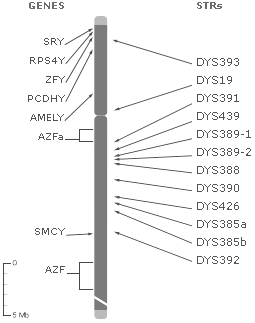
Y-Chromosome Your STRs
How to Interpret Your Results |
|
Genetic
History
Your Y-chromosome results identify you as
a member of haplogroup I.
Genographic Project Results
The genetic markers that define your ancestral history reach back
roughly 60,000 years to the first common marker of all non-African men, M168,
and follow your lineage to present day, ending with M170, the defining
marker of haplogroup I.
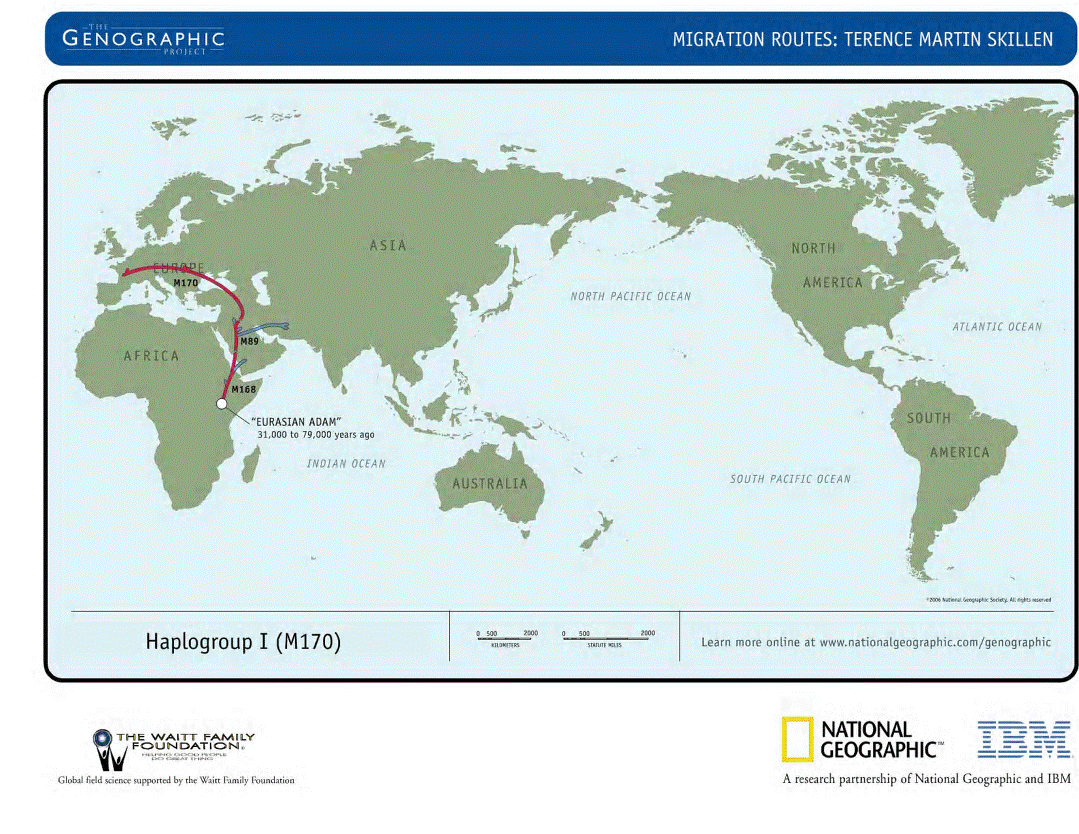
If you look at the map highlighting your ancestors' route, you
will see that members of haplogroup I carry
the following Y-chromosome markers:
M168 > M89 > M170
Today, members of this haplogroup can be
found throughout southeastern and central
What's a haplogroup, and why do
geneticists concentrate on the Y-chromosome in their search for markers? For that
matter, what's a marker?
Each of us carries DNA that is a combination of genes passed from
both our mother and father, giving us traits that range from eye color and
height to athleticism and disease susceptibility. One exception is the
Y-chromosome, which is passed directly from father to son, unchanged, from
generation to generation.
Unchanged, that is unless a mutation�a random, naturally
occurring, usually harmless change�occurs. The mutation, known as a marker,
acts as a beacon; it can be mapped through generations because it will be
passed down from the man in whom it occurred to his sons, their sons, and every
male in his family for thousands of years.
In some instances there may be more than one mutational event that
defines a particular branch on the tree. This is the case for your haplogroup I, since this branch can be defined by
two markers, either M170 or P19. What this means is that either
of these markers can be used to determine your particular haplogroup,
since every individual who has one of these markers also has the other.
Therefore, either marker can be used as a genetic signpost leading us back to
the origin of your group, guiding our understanding of what was happening at
that early time.
When geneticists identify such a marker, they try to figure out
when it first occurred, and in which geographic region of the world. Each
marker is essentially the beginning of a new lineage on the family tree of the
human race. Tracking the lineages provides a picture of how small tribes of
modern humans in
A haplogroup is defined by a series of
markers that are shared by other men who carry the same random mutations. The
markers trace the path your ancestors took as they moved out of
One of the goals of the five-year Genographic
Project is to build a large enough database of anthropological genetic data to
answer some of these questions. To achieve this, project team members are
traveling to all corners of the world to collect more than 100,000 DNA samples
from indigenous populations. In addition, we encourage you to contribute your
anonymous results to the project database, helping our geneticists reveal more
of the answers to our ancient past.
Keep checking these pages; as more information is received, more
may be learned about your own genetic history.
Your Ancestral Journey: What We Know Now
M168: Your Earliest Ancestor
Fast Facts
Time of Emergence: Roughly 50,000 years ago
Place of Origin:
Climate: Temporary retreat of Ice Age;
Estimated Number of Homo sapiens: Approximately 10,000
Tools and Skills: Stone tools; earliest evidence of art and
advanced conceptual skills
Skeletal and archaeological evidence suggest that anatomically
modern humans evolved in Africa around 200,000 years ago, and began moving out
of
The man who gave rise to the first genetic marker in your lineage
probably lived in northeast Africa in the region of the Rift Valley, perhaps in
present-day Ethiopia, Kenya, or Tanzania, some 31,000 to 79,000 years ago.
Scientists put the most likely date for when he lived at around 50,000 years
ago. His descendants became the only lineage to survive outside of
But why would man have first ventured out of the familiar African
hunting grounds and into unexplored lands? It is likely that a fluctuation in
climate may have provided the impetus for your ancestors' exodus out of
The African ice age was characterized by drought rather than by
cold. It was around 50,000 years ago that the ice sheets of northern Europe
began to melt, introducing a period of warmer temperatures and moister climate
in
In addition to a favorable change in climate, around this same
time there was a great leap forward in modern humans' intellectual capacity.
Many scientists believe that the emergence of language gave us a huge advantage
over other early human species. Improved tools and weapons, the ability to plan
ahead and cooperate with one another, and an increased capacity to exploit
resources in ways we hadn't been able to earlier, all allowed modern humans to
rapidly migrate to new territories, exploit new resources, and replace other
hominids.
M89: Moving Through the
Fast Facts
Time of Emergence: 45,000 years ago
Place: Northern Africa or the
Climate: Middle East: Semiarid grass plains
Estimated Number of Homo sapiens: Tens of thousands
Tools and Skills: Stone, ivory, wood tools
The next male ancestor in your ancestral lineage is the man who
gave rise to M89, a marker found in 90 to 95 percent of all
non-Africans. This man was born around 45,000 years ago in northern Africa or
the
The first people to leave Africa likely followed a coastal route
that eventually ended in
Beginning about 40,000 years ago, the climate shifted once again
and became colder and more arid. Drought hit
While many of the descendants of M89 remained in the Middle
East, others continued to follow the great herds of buffalo, antelope, woolly
mammoths, and other game through what is now modern-day
These semiarid grass-covered plains formed an ancient
"superhighway" stretching from eastern
M170: Occupying the Balkans
Fast Facts
Time of Emergence: 20,000 years ago
Place of Origin:
Climate: Height of the Ice Age
Estimated Number of Homo sapiens: Hundreds of thousands
Tools and Skills: Gravettian culture of
the Upper Paleolithic
Your ancestors were part of the M89 Middle Eastern Clan
that continued to migrate northwest into the Balkans and eventually spread into
central
The Gravettian culture represents the
second technological phase to sweep through prehistoric western
Europe. It is named after a site in La Gravette, France, where a set of tools
different from the preceding era (Aurignacian culture)
was found. The Gravettian stone tool kit included a
distinctive small pointed blade used for hunting big game.
The Gravettian culture is also known for
their voluptuous carvings of big-bellied females often dubbed "Venus"
figures. The small, frequently hand-sized sculptures appear to be of pregnant
women�obesity not being a problem for hunter-gatherers�and may have served as
fertility icons or as emblems conferring protection of some sort.
Alternatively, they may have represented goddesses.
These early European ancestors of yours used communal hunting
techniques, created shell jewelry, and used mammoth bones to build their homes.
Recent findings suggest that the Gravettians may have
discovered how to weave clothing using natural fibers as early as 25,000 years
ago. Earlier estimates had placed weaving at about the same time as the
emergence of agriculture, around 10,000 years ago.
Your most recent common ancestor, the man who gave rise to marker M170,
was born about 20,000 years ago and was heir to this heritage. He was probably
born in one of the isolated refuge areas people were forced to occupy during
the last blast of the Ice Age, possibly in the Balkans. As the ice sheets
covering much of Europe began to retreat around 15,000 years ago,
his descendants likely played a central role in recolonizing
northern
It's possible that the Vikings descended from this line. The
Viking raids on the British Isles might explain why the lineage can be found in
populations in southern
This is where your genetic trail, as we know it today, ends.
However, be sure to revisit these pages. As additional data are collected and
analyzed, more will be learned about your place in the history of the men and
women who first populated the Earth. We will be updating these stories
throughout the life of the project.
Results obtained by the Genographic Project: a research partnership of National Geographic and IBM with global field
science supported by the Waitt
Family Foundation.